Listen to This Article
Amazon isn’t new to AI. The ecommerce giant has been investing in and operationalizing artificial intelligence for more than two decades. From early product recommendation engines and the release of Alexa to advanced robotics and smart glasses for delivery drivers, Amazon has been investing in AI as a lever for customer satisfaction, supply chain management, and operational efficiency.
In this article, we’ll dive into ways Amazon is embedding AI functionality across its supply chain, how it impacts vendors, and what brands should be doing to stay aligned with an increasingly algorithm-driven marketplace.
Key Insights
- AI is becoming embedded across Amazon’s entire supply chain. From vendor tools to warehouse robotics and delivery optimization, Amazon is integrating AI into nearly every operational layer.
- Algorithms are increasingly shaping vendor performance and risk. Automated systems like DisputeGPT, return-rate monitoring, and AI review summaries are shifting more performance accountability to vendors.
- Structured data and operational accuracy are more important than ever. As AI tools interpret listings, performance, and documentation, vendors must maintain clean data, compliant processes, and accurate product information to remain competitive.
Areas Amazon is Expanding Its AI Investments
Amazon’s use of AI is vast — and ever-growing. In late 2025, Amazon announced plans to invest up to $50 billion to advance AI and supercomputing power for Amazon Web Services (AWS). But their AI investment isn’t just to its cloud platform, but also to the underlying systems that power Amazon’s retail operations, fulfillment network, and global supply chain.
Let’s take a look at some of Amazon’s AI investments in its supply chain:
Vendor Management
DisputeGPT
In 2025, Amazon rolled out DisputeGPT to enhance its dispute resolution process within Vendor Central. DisputeGPT reduces Amazon’s manual workload for processing vendor disputes by using AI to analyze submitted chargebacks and supporting documentation before a case is formally reviewed. Instead of relying solely on human reviewers, the system scans supporting documentation to determine whether a dispute meets Amazon’s predefined criteria — providing near-instant feedback inside Vendor Central.
What it means for vendors: For first-party (1P) sellers, dispute success increasingly depends on structured, accurate, and complete backup documentation at the time of submission. The upside is faster feedback and potentially fewer back-and-forth communications. The downside is a higher operational bar: vendors must ensure EDI accuracy, clean shipment records, and airtight compliance processes.
High Return Rate Penalties
In 2023, Amazon rolled out an algorithm that gives a “frequently returned item” badge to poorly performing products. In 2025, the badge was given more prominence, with a bold placement right next to the product details:

Not only can this feature make potential customers think twice about purchasing an item, but Amazon also introduced a High Return Rate Program Policy on June 18, 2025 that gives the retailer the authority to return unsold inventory at the vendor’s expense for any product carrying the badge. Under the policy, Amazon can initiate returns of remaining inventory, require vendors to issue full refunds, and charge an additional 10% shipping and handling fee, even if the units were never sold to a customer.
What it means for vendors: High return rates are no longer just a conversion problem; they are a financial risk. This policy shifts more performance risk from Amazon to the vendor. Vendors should proactively monitor return rate data in Vendor Central, audit product listings for clarity and accuracy, and address root causes quickly to avoid issues.
Vendor Tools
Vendor Central AI Assistant
Amazon’s platform for 1P sellers, Vendor Central, has an AI-powered assistant, called the Amazon Business Coach, that helps vendors find information faster, solve issues, and identify business growth opportunities. The assistant can help with tasks like updating ASIN attributes, creating variations, troubleshooting ASIN issues, checking sales and inventory, and other business guidance.
What it means for vendors: The AI assistant reduces friction and can speed up issue resolution, but it also signals Amazon’s broader shift toward automated and AI-powered solutions.
Optimized Product Listings
Amazon has also introduced an AI tool in Vendor Central that allows vendors to upload bulk catalog spreadsheets and automatically convert them into enhanced draft product listings. Importantly, this functionality focuses on enhancing new SKUs rather than updating already existing ASIN content. The AI helps standardize formatting, fill attribute gaps, and align listings with Amazon’s guidelines.
What it means for vendors: This feature can dramatically reduce time-to-launch for new products and improve content consistency across large catalogs. However, just like any AI function, it’s only as accurate as the data it is given. It’s crucial for vendors to ensure the catalog spreadsheets are accurate before they are passed to the AI for optimization.
A+ Content Support
Amazon is also leveraging generative AI to assist with A+ Content creation inside Vendor Central. Vendors can enhance product listings with AI-generated text and images, which are then added to the asset library.
What it means for vendors: AI-assisted A+ Content lowers the barrier to high-quality merchandising and can help smaller brands compete visually with larger brands. However, it’s the vendor’s responsibility to ensure images and text are correct/factual and don’t violate any third-party rights. Vendors should carefully review assets before accepting responsibility for them through publication.
Customer Service/Satisfaction
Review Summaries
Since 2023, Amazon has used AI to generate concise summaries of customer reviews on product pages. Instead of shoppers scrolling through hundreds or thousands of reviews, the system identifies recurring themes (positive, negative, and neutral) and surfaces them in a short paragraph at the top of the review section.
For example, here’s a product summary for a curtain rod:
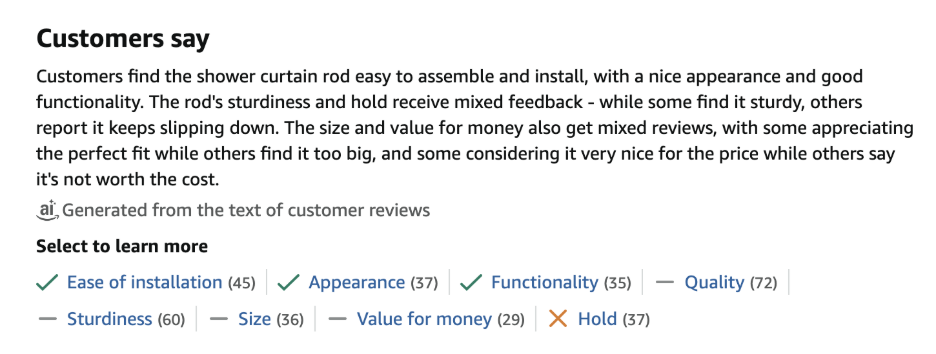
What it means for vendors: AI-generated review summaries put customer sentiment into a highly visible snapshot. Vendors no longer have the advantage of burying negative feedback beneath positive reviews, as recurring issues are algorithmically elevated.
This increases the operational importance of addressing product issues quickly. Quality control issues, packaging defects, unclear instructions, or misleading product information can rapidly become embedded in the summary. On the positive side, strong performance and consistent satisfaction are rewarded with prominent reinforcement.
Rufus
In 2024, Amazon launched its customer-facing AI tool, Rufus. The AI-powered shopping assistant helps customers compare products, ask detailed questions, and receive personalized recommendations directly within the Amazon app and website. Rufus can answer product-specific questions, summarize features, compare alternatives, and provide contextual buying advice based on shopper intent.
What it means for vendors: Vendors must ensure that product content, specifications, and attribute data are structured and complete so the AI can accurately interpret and recommend their products.
Operations and Logistics
AI-Powered Warehouses
Amazon has transformed its fulfillment operations by integrating artificial intelligence and robotics into its warehouse network. The company has deployed more than one million robots, including autonomous drive units and robotic arms that assist with sorting, transporting, and packing items. These AI-powered systems significantly improve efficiency by reducing the time it takes to process orders while lowering operational costs.
What it means for vendors: Amazon’s AI-powered warehouses could benefit vendors through faster order fulfillment, improved inventory management, and potentially lower storage and shipping costs. However, vendors may also face stricter inventory requirements, tighter compliance standards, and increased pressure to keep up with Amazon’s faster delivery expectations.
Delivery Optimization
Amazon is introducing new technologies to improve delivery efficiency and safety, including AI-powered smart glasses and virtual reality driver training. The smart glasses allow delivery drivers to view package details, follow directions, and confirm deliveries hands-free. The system can also identify potential hazards, like pets or walkway obstructions, during deliveries. In addition, Amazon has implemented virtual reality training programs and driving simulators that prepare drivers for real-world scenarios to improve safety and performance.
What it means for vendors: These innovations could lead to faster, more reliable deliveries and fewer errors, improving the customer experience for vendors selling on Amazon. However, as delivery performance improves, vendors should ensure their operations are prepared to meet higher expectations.
Level Up Your Supply Chain with AI
While this article scratches the surface of the ways Amazon is utilizing AI, it makes one thing evidently clear: AI tools are most powerful when they’re embedded throughout the supply chain — not simply layered on as an afterthought. MAX, the SPS Commerce AI solution, brings this concept to life by embedding intelligence directly into day-to-day workflows. Built on a network of more than 300,000 trading connections and billions of transactions, MAX helps teams identify potential issues early and make faster, more informed decisions across their supply chain.